


There are so many tips for booking a flight available online!
And, when you begin to research which are the best places to search or what day of the week you’ll find the best deals, it inevitably leads to head-spinning analysis paralysis.
This guide will show how to book a flight the best way. And, even though tips about how to book a flight online come and go, the tips below are what I’ve used successfully over and over to book flights for my travels.
15 Tips for Booking a Flight the Best Way to Save Money

1. Search Using a Flight Aggregator.
Not all flight search engines are equal. It does matter where you search.
Tools like Google Flights, Skyscanner, and Momondo are the best ones to search for the flights you need. They show real-time schedules and pricing info from the airlines, as well as have features that help you see which days are the cheapest to fly. You can also use filters to hone in on the flights you want based on duration, airlines, stops, times, and more.
If you’re wondering what the difference is between an aggregator and other travel booking sites, let me explain.
Aggregators are different from traditional online booking websites because they redirect you away from their own websites when you’re ready to book. Oftentimes, you’re sent directly to the airline’s website to complete your transaction.
Unlike online travel booking websites, aggregators aren’t showing you results that steer you towards booking with them or one of their partners. You’re getting independent flight data that these aggregators have pulled directly from the airlines.
What’s more, many online travel booking websites are owned by larger parent companies. So, even when you’re searching across different online travel booking websites, you likely aren’t truly comparison shopping. Instead, you’re searching on sites that are all partners with the single goal of getting you to book with them.
You inevitably see similar pricing and this reinforces the belief that you’ve found the best price because they all fall within the same range.
All of this while an aggregator may have a lower price because it’s showing exactly what the airline is charging.
2. Be Flexible with Dates.

I get it. As someone who was tied to the school calendar, sometimes you have no wiggle room with your travel dates. If this is you, keep reading for other ways you can potentially use flexibility in your favor. However, for those of you who can be flexible with your dates but are committed to only flying on a specific day, you’ll likely pay for this convenience.
On the other hand, if you’re open to being flexible about when you travel, use the fare calendar, date grid, or price graph on Google Flights to find the cheapest date combinations for your trip. Skyscanner and Momondo have similar features that allow you to see the price fluctuations so you can choose the best option.
I have leveraged this “trick” with both cash flights and miles and points flights to save again and again. Whenever I search for flights, my initial search dates are just starting points. From there, I make adjustments based on the price I am seeing.
3. Be Flexible with Airports.

The more flexibility you can infuse into your travel planning, the more you’re likely to save. And while we all like to fly directly from our home airports to our destination, I always compare nearby airport options, too. Sometimes, this tiny change can lead to big savings.
Think about the airports you can comfortably drive to and then search for departing flights from all of them. Repeat this for your destination whether you’re searching for domestic trips or international trips.
In well-connected cities across the globe, you’ll often have more than 1 airport option. For example, there are 11 airports in northern Italy. Milan alone has 3 near the city.
It might even be smarter to position yourself close to your destination because it’ll be cheaper to go from there to your final destination rather than fly there directly from your home airport.
For example, let’s look at that trip to Europe you want to take. Flights to Paris may be pricier than flights to Brussels. Yet the 2 cities are less than a 2-hour train ride apart. It may make more sense to fly to Brussels and either go directly to Paris from there or add an extra city to your trip rather than pay more to fly straight to Paris.
4. Be Flexible with Destinations.

Of all the flexibility tips, this one might be the hardest to wrap your head around. After all, you’ve chosen a travel destination and, once it’s in your mind, it’s hard to un-imagine it.
But, if you’re like me and a lot of travelers, your list of places you’d like to visit is long. So why not see which destination is more affordable for when you want to travel rather than setting your mind to a specific place without any research?
Google Flights, Skyscanner, and Momondo all let you type “everywhere” or “anywhere” into the destination field. You can also type “Europe” or “South America” if you’d like to slightly narrow down your search. Either way, you can look for lower prices for a range of places instead of a set destination.
I also like Momondo’s “type of trip” filter. You can set the filters to things like “romantic,” “beach,” or “outdoorsy” and the aggregator will find the best-priced destinations that match this theme.
I had one of the best solo trips ever when I used this flexible destination strategy. I had a set 2-week break from teaching so I had no date flexibility. But I was open-minded as to where so I let the destination choose me based on what cheap flight deal I saw.
5. Be Flexible with Routing.

We all prefer a direct flight. It saves the possible headache of missing a connection and reduces the chance of luggage getting lost. That being said, there are also potentially significant savings when you book a flight with a stop.
It seems completely counterintuitive. Wouldn’t it cost more for an airline to fly you here and then there, as opposed to directly where you want to go? But, it’s not necessarily the case.
As you use a tool like Google Flights, compare the costs between direct flights and those with a stop. You might be surprised at the price difference. Just remember, always choose an itinerary that allows for enough time for you to make your connection.
For example, if you’re flying to Athens with a stopover in Paris, give yourself at least 2 hours to make the connection. Charles de Gaulle Airport in Paris is massive and you’ll need to pass through another security check and immigration before continuing to Athens.
In general, I typically look for connections of at least 2 hours unless I know the airport is small or is easy to navigate. I never book itineraries with connections less than 1 hour and you shouldn’t either.
ProTip: If there’s one thing you take from this booking flights guide, it should be the idea of flexibility. The more ways you can be flexible, the more you’ll save on booking flights.
6. Use Positioning Flights.

Piggybacking on the tip above, you might also consider flying to a different airport to get the flight you actually need to reach your destination. This is commonly known as a positioning flight.
Consider this scenario. Let’s say you live in Pittsburgh. You want to get to Stockholm, Sweden. Your flight search results have at least 1 connection (many have 2 connections) because there are no direct flights from your home airport to Stockholm.
It may seem like you need to choose the best option from these results. But why not look at positioning yourself on a cheap flight to an airport with direct flights to Stockholm?
Newark Airport has direct flights to Stockholm. It’s worth it to see if you can get a cheap flight separately to Newark and then book the round trip to Stockholm from Newark. The price may be better (and the routing, too!) than bundling the entire itinerary together.
Miles and points enthusiasts do this all the time. We will position ourselves at different airports to book long-haul flights with premium seat availability. This strategy can also be used effectively with cash bookings.
7. Leverage Budget Airlines.

Especially for short-haul flights, low-cost carriers can save a lot of money. The thing is that not all of them show in the search results when using online travel booking sites and, sometimes, even Google Flights.
Airlines like Ryan Air and Air Asia might be familiar budget airlines if you’ve traveled to Europe or Asia. But have you heard of Scoot, Jetstar, Lion Air, or Wizz Air?
To find out if there’s a budget airline flying a route I need, I’ll check the Wikipedia page for my destination airport by searching “(Destination Name) airport Wiki.” From there, open the Wiki page and scroll to the “Airlines and Destinations” table. You’ll be able to see every airline that operates at the airport and where they fly from.
If you see an airline that you don’t recognize and you’re not seeing as you search more mainstream search tools, visit the airline’s website directly. You might be surprised at how cheaply you can fly quick-hop flights between 2 cities.
8. Sign Up for Cheap Flight Alerts.
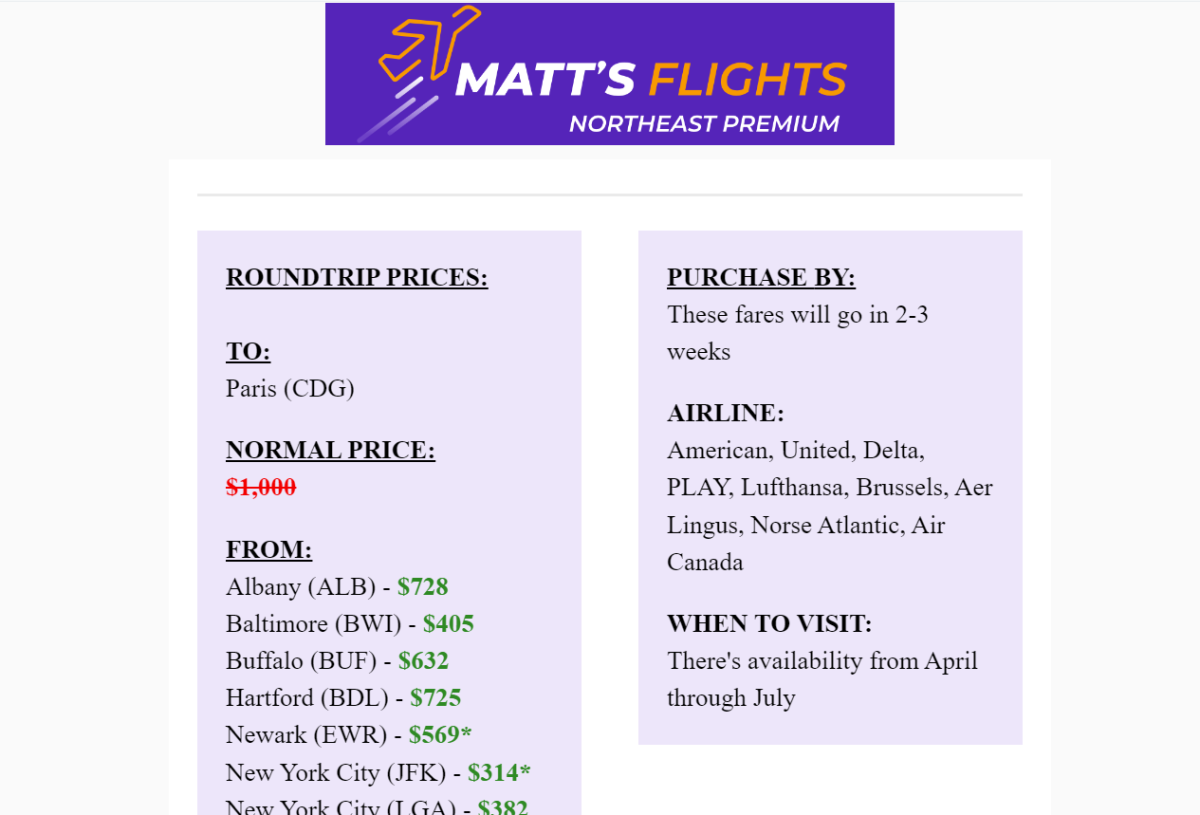
It’s impossible to search airfares 24/7 on your own in the neverending quest for the best flight deals. That’s where signing up for cheap flight alerts comes in handy.
Services like Matt’s Flights or Going offer yearly plans to members. In exchange, you’ll get emails alerting you as soon as a great deal comes up. Sometimes this could be 1 email in a day and other times it could be 5 emails in a day depending on flight pricing.
The potential savings here could be massive but you also have to be in the mindset of being flexible with your destination. If you were thinking of a trip to Madrid, but a cheap flight to Lisbon pops up, it’s advantageous to book the flight to Lisbon and either incorporate that into your itinerary or position yourself on a cheap flight to Madrid.
The other thing to know is that deals come and go. So, when you see these deals land in your inbox, you have to act fast. This is especially the case with mistake fares, which can be corrected by the airline at any moment.
And if you don’t want to spend a few bucks on a cheap flight alert service, set an alert with Google Flights or Hopper to let you know when ticket prices are fluctuating. You can also use travel websites like Secret Flying or The Flight Deal to scan for cheap airfare and travel deals.
9. Take Advantage of the 24-Hour Rule.

In case you didn’t realize, it’s required by the U.S. Department of Transportation that all airlines who operate flights to or from the United States must offer either a 24-hour free cancellation policy or the ability to hold your price for free for 24 hours. The only stipulations are that you must book the flight directly with the airline and the booking must be at least 7 days before your flight.
So, why is this included in these tips for booking flights? This rule lets you jump on a deal when you see it knowing that you can cancel within 24 hours without a penalty as long as you’ve met the stipulations above.
For example, if you receive a cheap flight alert from the U.S. to Ecuador, you can book it and then pause and think afterward without worrying that you’ve just done something you shouldn’t have.
10. Get Creative with your Flight Bookings.

Traditional round-trip itineraries aren’t always the most value for your money. Similar to looking at flights with a connection, sometimes it makes more sense to book one-ways, an open-jaw itinerary, or even add a stopover.
An open-jaw flight is when you fly into one city and out of a different city. This can end up saving you money, time, and stress.
Think about a typical European trip which usually includes a few different cities in several countries. Perhaps you want to visit Prague, Vienna, and Budapest. It’s better to fly into Prague or Budapest and fly out of the other.
The train can get you from city to city. You’ll not only avoid backtracking to your arrival city, wasting valuable vacation time, but you’ll also save money on transportation and likely not pay much more (if any) than you would for a typical round trip.
To search this way, use the multi-city function search on most airline and travel booking websites to search for open-jaw itineraries. It’s also worthwhile to search for one-way tickets and compare the difference between these results and multi-city bookings.
Some airlines even allow you to add a stopover for no extra money for a couple of days in a city before moving on to your final destination. Airlines like Air Canada, TAP Air Portugal, Icelandair, Emirates, Turkish Airlines, Qatar Airways, and Etihad let you add a free stopover to your itineraries.
Now, it’s important to understand the rules surrounding these stopovers. For example, TAP Air Portugal lets you stop in Lisbon or Porto for 1-5 nights for no additional cost before flying you to another European city.
I may not have been the best math student 😉 but 2 destinations for the price of 1 sounds like a great way to save money on plane tickets!
11. Understand How Fare Classes Can Increase Your Price.

I admit I am an aviation nerd. But I won’t bore you with paragraphs of details on this one. But, knowing a few booking tips on this one could help to save money.
Basically, airlines group seats into fare classes. These buckets are identified with a letter. For example, the “Y” fare class stands for full-price economy. But other letters like “M, E, K, or G” can also stand for economy class. The difference is each fare class has its own rules (refundable/nonrefundable, number of bags, how many miles can be earned, etc).
On any given flight, there are a specific number of seats designated to each fare class. When they’re sold out, no more in that given fare class are available for that particular flight.
This could affect you when you’re searching for a flight for multiple people. Let’s say you need 4 airline tickets in economy but only 3 seats in the cheapest economy fare class are available. Your search results will show 4 tickets in the higher-priced fare class and you won’t know that there are 3 seats at a lower price.
To combat this, search for airfare for 1 person first to understand the best price available. After this, you can better detect price inconsistencies searching for multiple people at once.
If this happens to you, search for 1 person, then 2, etc to understand how many seats are available in a cheaper fare class. While you might not save money on all 4 tickets, you can potentially get some of them at a better price than buying them altogether.
12. Book Award Flights with Points and Miles.
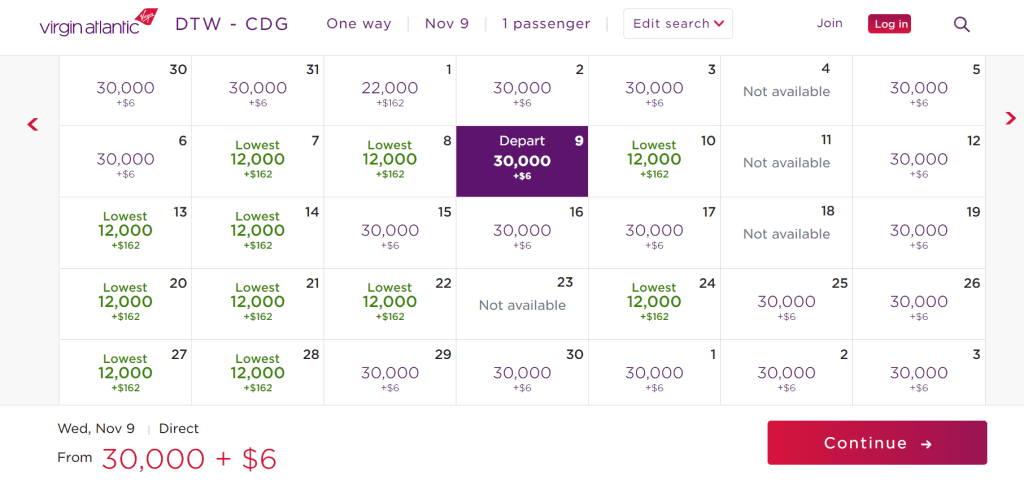
I am a points and miles girl. Travel rewards points and airline miles have been the main reason why I have been able to travel so much.
But I realize that a lot goes into leveraging this strategy. While it’s easy to earn miles and points with travel rewards credit cards, most people stumble when it comes to redeeming them for the best value. Even still, earning miles and points from your everyday spending and then redeeming them for award flights doesn’t have to be complicated.
There are travel portals through banks like Chase or Capital One which make booking award flights a more straightforward process. It might not be the absolute best return value but it could help you easily book a free flight.
If you’d like to get started and go deeper with miles and points, check out my free Travel Hacking Basics course to establish a firm foundation. You’ll find tips on the best rewards-earning credit card but also important information about searching and booking award flights.
13. Don’t Travel During Peak Season.

This tip for booking flights is a bit of a double-edged sword for me. Many people are tied to a school calendar or can only take off from work during certain times of the year. As someone who taught for many years, I know all too well what it’s like to only be able to travel during school vacations. If I had followed this advice, I would never have gone anywhere.
But, I also realize that these times are the most expensive time of year to travel. Everyone wants or needs to travel around major holidays, spring break, and during the summer. Prices naturally go up with the demand.
Also, recognize that cheaper flights are harder to find around major events. If you want to go to a festival, sporting event, or conference, you’ll get a better deal arriving at least a few days before the event starts rather than the day before it starts.
So, if you’re someone who can avoid traveling during these busier times, then it’s a no-brainer to book travel during less busy months.
14. Know the Best Time to Book Airfare and When to Fly.

Airfare prices change all the time which is exactly what can lead to analysis paralysis. You keep wondering whether it’s the right time to book or fly. Ignore advice about what day of the week you should book airfare. You don’t need to wake up at midnight early in the week to land the cheapest flights.
Instead, understand that generally speaking the prime booking window for domestic flights is at least a month in advance. For international flights, you should try to book at least 2 months ahead of time.
But keep in mind, this isn’t a science. It’s sometimes entirely possible to find closer-in or last-minute flights at a cheaper price. So, just store this tip away as a good rule of thumb to remember.
Likewise, as you search on tools like Google Flights and see the calendar view of fares, you’ll inevitably notice that Tuesdays, Wednesdays, and Saturdays are typically the cheapest days to fly. Going back to being flexible with your dates, if you can fly on the cheapest day, it makes sense to adjust your timing to match this.
It’s also worth checking the cheapest time on any given day. Depending on your destination, an early morning flight might be the cheapest airfare or it could not be. Similarly, fewer people may want to fly late at night or even overnight.
15. Book in an Incognito Window. (Does this actually work?!)

I disagree with anyone claiming that searching for flights in a private browser window doesn’t sometimes make a difference. I’ve seen firsthand for several of my own flight searches done in regular browser windows how prices went up after repeated searches.
Naysayers will explain this with information about the constantly changing algorithms of airline pricing. I’m even willing to agree with this to a point. Prices do change quickly. If you see a price that looks good, you should book it.
However, over the years, I’ve had several specific instances of seeing flight prices rise with repeated searches. Yet once I moved to a different device (PC to iPad, for example) and repeated the search in a private browser window, the original lower price reappeared. This cannot be explained just by normal price fluctuations.
Feel free to take this tip with a grain of salt. I certainly don’t rely on it as my main strategy for finding cheap flights. However, I consider it still to be a tool to be aware of as you do your flight searches.
Tips for Booking Flights
No matter where you want to go, knowing these basic flight search tips can help you be strategic and save money on your airfare bookings. The goal is to find a balance between putting these airfare booking tips to use and not over-analyzing to the point of feeling overwhelmed by the whole process.
So whether you’re someone who can leverage flexibility or you’re able to act quickly when a cheap flight alert pops up, the key is developing a flight search strategy that works for you so that you can confidently book your flights knowing you got a good deal.
What’s your top tip for booking flights?
Like this post? Please share it on social media using the share buttons below!
