


On a trip to Patagonia, I found myself with 1 day in Santiago, the capital of Chile. And I’m so glad I did!
Santiago is one of the gateway cities, along with Buenos Aires in Argentina, if you’re heading to Patagonia. It’s easy to catch buses or hop on flights to head further south. You may also find yourself with one full day in Santiago while in transit to one of Chile’s many popular spots, like the Lake District, Valparaiso, Atacama Desert, or even Easter Island.
So if you’re like me, you might be asking yourself – Now that I have a day in Santiago, what should I do?
Below, you’ll find ideas for planning your entire day and exactly what I did with just 24 hours in Santiago.
Have a look!
How to Spend 1 Terrific Day in Santiago, Chile

While it’ll be difficult to really get to know Santiago in just 1 day, the city has become increasingly cosmopolitan and offers plenty for a traveler in transit to get a sense of the city.
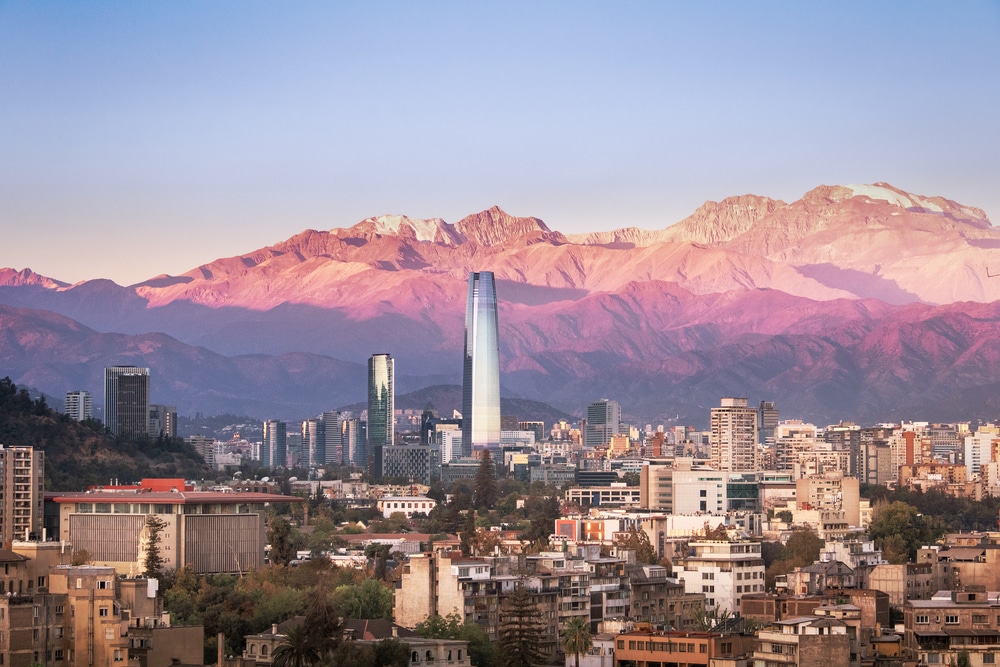
As the largest city in Chile, Santiago de Chile (its official name) is nestled between the Andes Mountains and the Pacific Ocean, with a rich blend of historic charm and modern flair. With its bustling neighborhoods, renowned culinary scene, and stunning views, a day in Santiago is a perfect addition to your Patagonia adventure.
1. Take a free Santiago walking tour.
After some breakfast, I began my day with a free walking tour. I wanted to go with a guide particularly because I didn’t want to lose time trying to figure out my way around Santiago. Plus, I love walking in a new city to get a sense of what it’s all about. But you could easily start your day doing something else and then go for the afternoon tour if you prefer.
Santiago Free Walking Tours runs English-speaking tours every day at 10 a.m. and 3 p.m. If all you have is 1 day in Santiago, a walking tour will give you a great overview of the city, as well as some of the local history and culture.
Tour groups meet outside of the Cathedral in the Plaza de Armas. There’s no need to make a reservation for the free tours. Just show up and look for the guide dressed in the red “Free Tour” t-shirt.
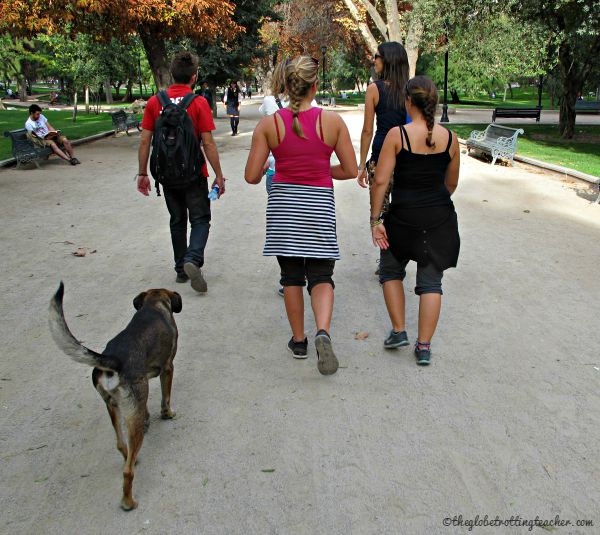
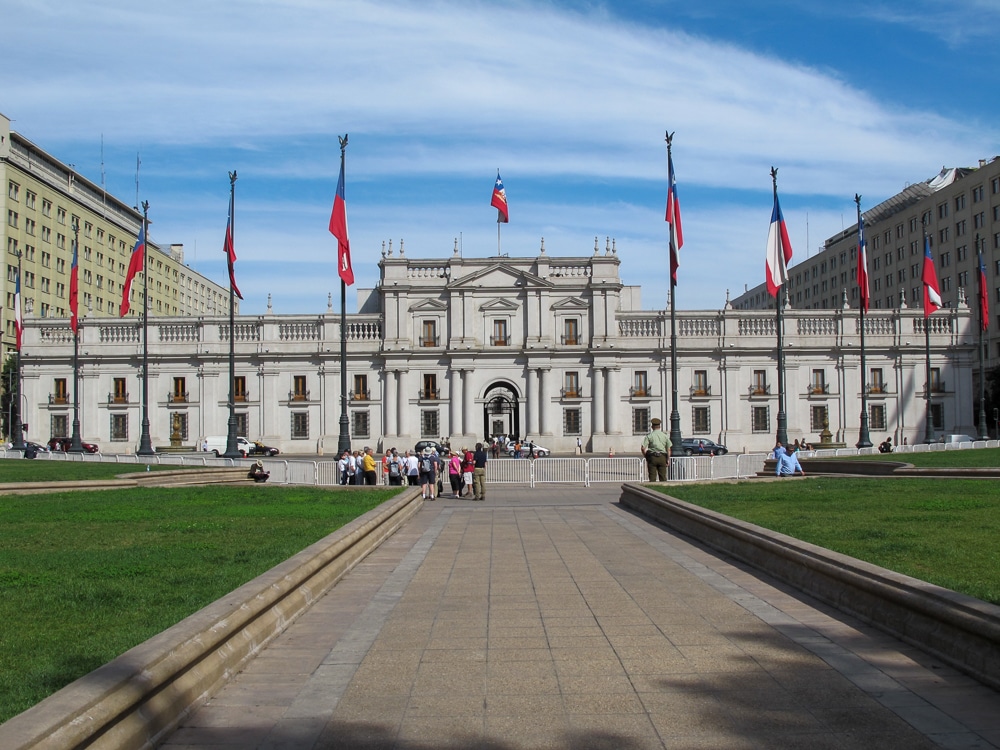
Going with a guide added context to Santiago’s history and culture. Instead of just stopping to take a photo of the Palacio La Moneda, Chile’s presidential palace, the guide told about the military coup staged by Pinochet in 1973. At the Casa de Pablo Neruda (Neruda Museum), we stopped for a moment to hear more about his life as a Chilean poet and diplomat and how his poetry has been recognized as some of the best ever written.
The guided tour moved along like this throughout the city at a comfortable pace and included a couple of stops where we could get something to eat or sit for a moment. In the end, the tour took about 4 hours and ended at the Neruda Museum just a 3-minute walk from the base of Cerro San Cristobal.
Our guide answered all of our questions and gave great local advice about restaurants, foods to try, and museums to visit. All of us were more than happy to tip him well at the end, and if you feel as if your guide has done the same, you should do so, too!
There are more terrific free walking tour options to consider. Sandeman’s might be a name you recognize from their free tour offerings in Europe. But they also partner with Tours4Tips in Santiago, too.
They have a 10 a.m. tour called, “Alternative Free Tour of Santiago de Chile,” where you’ll explore off the beaten path in Santiago by walking through local markets, parks, and the public cemetery, where many of Chile’s Presidents are interred. You’ll also have the chance to learn about neighborhoods like Esmeralda and the multicultural, Patronato.
Their 3 p.m. tour features Santiago highlights, visiting cultural and government landmarks to introduce the city and its history and culture to a first-time visitor like the tour above that I took.
Each of these tours is about 3 hours long. You need to book your tour (for $0) online so they have guides ready for you. You’ll meet your guide wearing the red and white striped shirt at the front of the Museo Nacional de Bellas Artes (Fine Arts Museum) at the intersection of Ismael Valdes Vergara and Loreto.
ProTip: For a more personalized experience exploring Santiago, consider booking a private tour. You’ll be able to choose when and where to go, see hidden gems, and get local tips. This could also end up being a more streamlined way to visit the places you want to see and be a bit shorter than one of the free walking tours.
2. Head up to the top of Cerro San Cristobal.

Head up more than 1,600 feet (500 meters) to the Cerro San Cristobal look-out point for sweeping views of Santiago and the surrounding Andes Mountains. You can also take advantage of some of the mountaintop trails and stop for a snack or coffee at one of the cafes on top.
To reach the top, you can hike up to the vantage point, take the cable car, or ride the funicular. The walk up is steep and will take about an hour to reach the top. With just 1 day in Santiago, I’d recommend skipping the walk to save time.
The most common way to the top is to take the funicular from the Bellavista neighborhood. It’s not far from the Bellavista restaurant area and about a 15-minute walk from the Banquedano or Patronato Metro stations.
The funicular is a tram that runs on a track up the hillside and stops at the National Zoo, a botanical garden, and Parque Metropolitano before finally reaching the sanctuary and white statue of the Virgin commemorating the Immaculate Conception. From here, outstretch your arms and (hopefully!) enjoy the views!
The cable car or teleferico runs on a cable and takes you up off the ground to the top of the mountain. The station is located at the base of the mountain near the station for the funicular.
Both are open at 9:30 a.m. from Tuesday through Sunday. On Mondays, the cable car is closed and the funicular is only open from 1 p.m. to 6:45 p.m. and it’s completely closed on the first Monday of every month.
A roundtrip funicular ticket to the summit costs $2,150 CLP or about $2.40 USD. A roundtrip cable car ride to the summit costs $3,650 CLP or about $4.10 USD. You might also want to take one up and the other down just to experience both. One-way tickets are available as well.
To plan your day in Santiago, you could spend as little as half an hour at the top to take photos and enjoy the view. I went later in the day as the sun began to dip and it was really pretty. If you’re also considering the Santiago Hop-on-Hop-off bus (more on this below), this ticket is a combo and includes access to the cable car and funicular.
Keep in mind, Santiago is a large city with a smog problem, but rain helps reduce smog. So, if you’re timing is right and the day before had rain, you’ll likely have fantastic views! On the flip side, if you have a cloudy, low visibility smoggy day, it might not be worth the time if the mountains and even the cityscape are partially or completely blanketed.
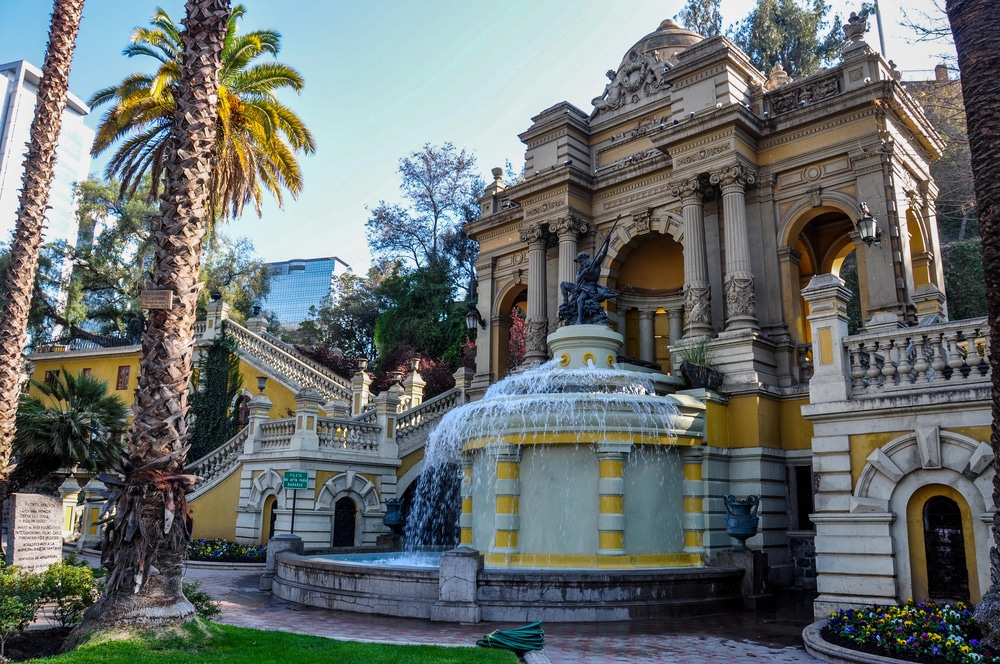
ProTip: An alternate hill to visit in the city is Cerro Santa Lucia, located in the center of Santiago in the Lastarria neighborhood. The top of this 200+ foot hill also comes with sweeping views of the city. There are walking paths and stairs to the top. The fountains and gardens are beautiful too! Best of all, it’s free to visit and open to the public.
3. Stroll through the Plaza de Armas and see the Cathedral de Santiago.
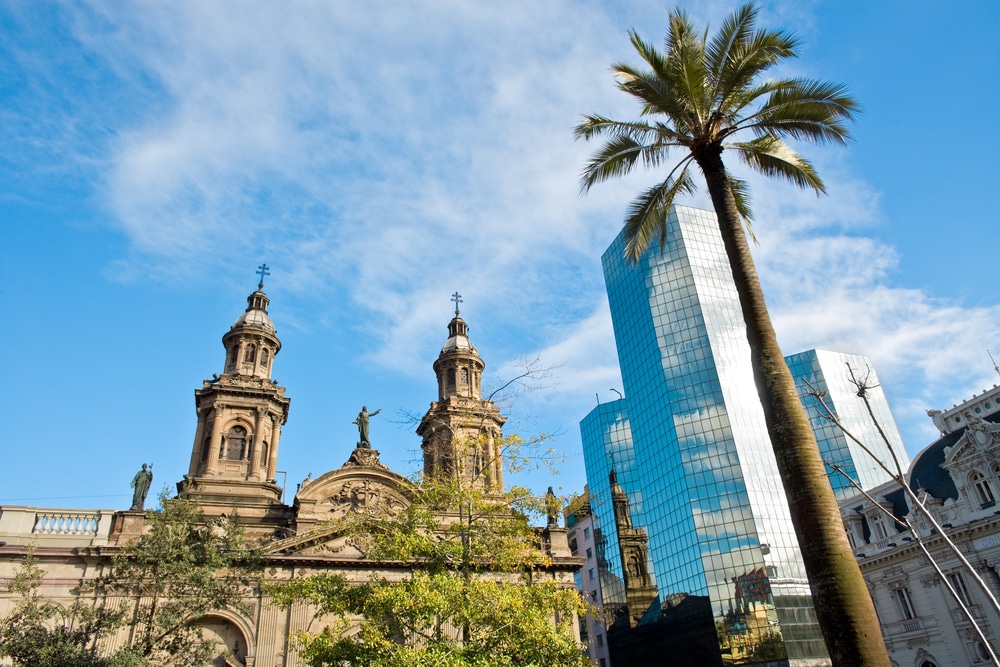
The historic Plaza de Armas is Santiago’s most popular city square, with the Cathedral de Santiago, the Central Post Office, and other government buildings.
The square is a great spot to see some of Santiago’s neoclassical architecture together with the city’s palm trees, stately fountains, and historical statues. Stop into the Cathedral de Santiago (also known as Metropolitan Cathedral), which was completed in 1800 to see its beautiful design and artwork. It’s open weekdays from 10 a.m. to 7 p.m.
If you decide to take part in a Santiago Free Walking Tour, keep in mind the tour meets outside the Cathedral but didn’t go inside when I was there. Luckily, our guide talked about the cathedral’s history and architecture and then gave us a few minutes to go inside on our own before we moved on.
Whether you do a free walking tour or explore on your own, make a point of visiting this square and Cathedral.
4. Visit one of Santiago’s museums.
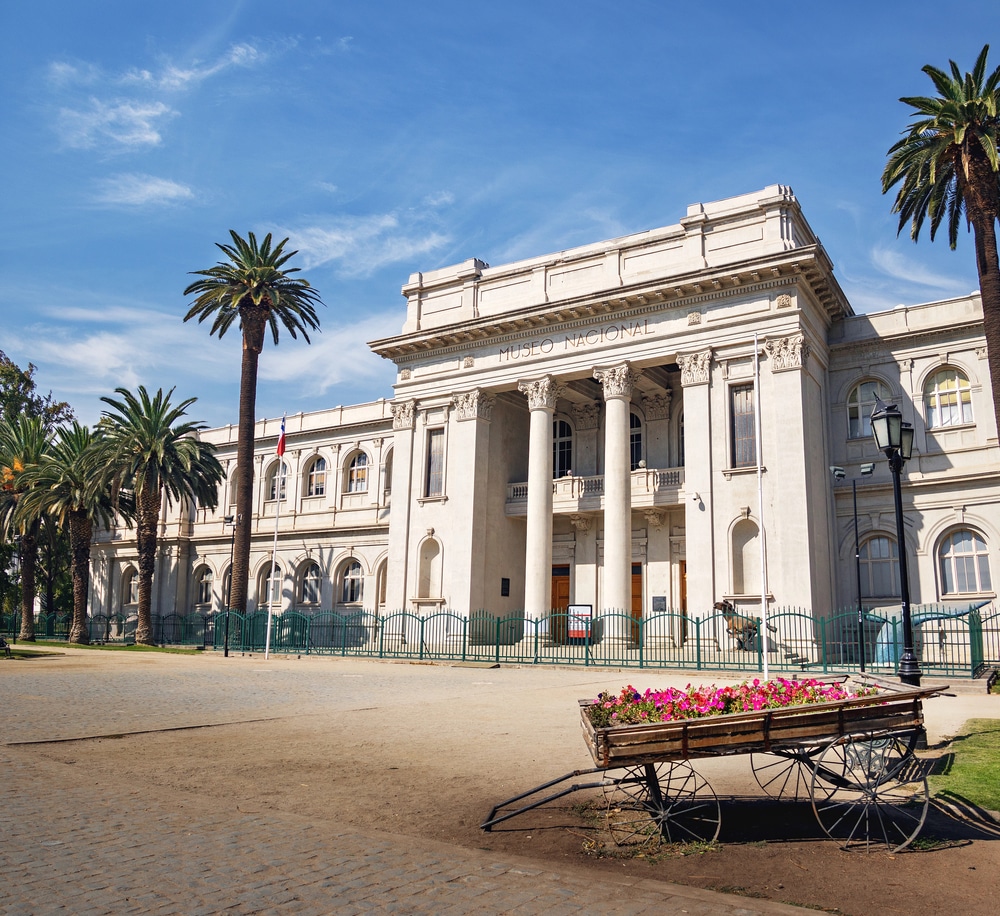
If you’re in Santiago any day Tuesday-Sunday (Santiago’s museums are closed on Mondays) stop in to admire the indigenous people’s artifact collections at the Chileno Museum of Pre-Columbian Art (Museo Chileno de Arte Precolombino).
The museum is just a 5-minute walk from the Plaza de Armas. Despite its small size, the museum packs many objects of interest, including Andean mummies that are older than the Egyptian mummies! Exhibits are in both Spanish and English. The museum is open from 10 a.m. to 6 p.m.
If you’d like to better understand some of Chile’s more recent history, the Museo de la Memoria y los Derechos Humanos (Museum of Memory) is a human rights museum to remember the victims of the Pinochet Regime.
This museum was opened in 2010 by the Chilean government, with the intent of publicly acknowledging and reflecting on the violations committed against its people.
From the Plaza de Armas this human rights museum, take the Metro (L5) to the Quinta Normal station. Normally, the museum is open from 10 a.m. to 6 p.m. In the summer (January-February), the museum extends its hours to 8 p.m., making this a good choice for the late afternoon or early evening, after having enjoyed a free walking tour and/or some of Santiago’s other sights.
ProTip: The Museo de la Memoria y los Derechos is located in the Yungay neighborhood of Santiago, right next to the Barrio Brasil. Both neighborhoods are great places to look for street art if that’s something you like to see.
5. Eat and drink in Barrio Bellavista.

Barrio Bellavista neighborhood is Santiago’s artsy, intellectual neighborhood, as well as the heart of the city’s nightlife scene.
Once home to Pablo Neruda, there’s now the University, markets selling artists’ wares, and street food vendors selling local snacks. There’s no shortage of restaurants, bars, and nightlife lining the streets around Pio Nono and Constitucion.
This is a great spot to land by late afternoon to early evening for a drink or early dinner. Find yourself an outdoor seat, where you can enjoy a Pisco Sour with some local Chilean dishes. If you stay after dark, watch your belongings and your drinks.
ProTip: La Chascona, the former home of Pablo Neruda, is now a museum located just a 5-minute walk from the Pio Nono area in Bellavista (near the funicular and cable car to Cerro San Cristobal). Some of the free walking tours end at La Chascona making this an ideal time to stop in and learn more about the Chilean poet’s life if you’re interested. The museum is open Tuesday to Sunday from 10 a.m. to 6 p.m.
6. Explore Santiago’s food markets.

Mercado Central is Santiago’s fish market, reached by a 5-minute walk from the Plaza de Armas.
You can also eat lunch here, but unfortunately as it has become more touristy, the quality of the food has gone down and the prices have gone up. Still, it’s worth at least a look.
I would recommend sticking to the edges instead of eating at the restaurants in the center. Do your best to ignore the many touts trying to get you to eat at their restaurants. Personally, I recommend eating elsewhere.
Alternatively, Santiago’s La Vega Central Market is known for its incredible and huge selection of fresh, cheap produce, fish, meat, flowers, and other foods for sale.
If you’re looking for a more local feeling, this is the market to choose. With only a day in Santiago, it’s a great cultural experience to see this slice of daily Chilean life.
Keep your wits about you at all times to safeguard your personal belongings whichever market you choose. And if you plan to visit, do so by the time the midday lunch period has ended.
7. Do a Chilean wine tasting.

Chile is famous for its wines and even though you’re in the heart of the Chilean capital, you’re not far from some of the country’s wineries and vineyards.
If you want to learn more about Chilean wine-making take a look at this wine-tasting tour. I considered doing it because the tour is relatively short, but in the end, I decided to spend my one day in Santiago completely in the city.
But if you love Chilean wines, you’ll get to see how wine is made from start to finish. You’ll learn how grapes are cultivated and see both modern and 19th-century wine-making techniques.
This is one of the oldest vineyards in Chile and along the way you get to see the mountains in the Maipo Valley.
Where to Stay in Santiago Chile
If you’re a first-time visitor to Santiago, Chile, it’s a good idea to stay around the Centro area, ideally in Barrio Lastarria. Not to mention that with a short visit to the city, it makes the most sense to stay closer to the main sights to maximize your time.
Barrio Lastarria is one of Santiago’s most lively and charming neighborhoods. It’s a great place to stay, offering a mix of historic architecture, cultural attractions, and modern amenities. You’ll find plenty of restaurants, cafes, and bars serving Chilean and international cuisine. The neighborhood is also home to boutique shops and street markets where you can buy local arts, crafts, handmade goods, and souvenirs.
I had a fantastic stay at Hostal Rio Amazonas, just a couple of blocks from the Metro and the vibrant downtown area. The place is colorful and cozy, making you feel welcome right away. Don’t be thrown by the word “hostal.” I had my room and bathroom.
I loved the Latin American folklore crafts and music, as well as the vintage furniture in my room. I was traveling solo, too, so I really appreciated being warmly welcomed by the staff and given helpful information about the area and city.
The hostal was on the border between Barrio Lastarria and the Providencia neighborhood another great area to stay in Santiago. Providencia and Lastarria are relatively close to the funicular to Cerro San Cristobal.
If you want to stay around the Centro, also consider Casa Bueras Boutique Hotel, a quaint hotel close to Barrio Lastarria and other top sights near the city center.
Hotel Magnolia is also a fantastic option depending on your budget that is also close to the main square, Plaza de Armas.
Travel Tips for Santiago
Whether you’re a first-time visitor or a seasoned traveler, navigating a visit to the capital city of Santiago can be both exciting and challenging, especially with just 1 day. To help you make the most of your trip, here are some practical tips that I used on my trip.
How to Get from the Airport to the City Center
There are plenty of options available to make your journey to the city center a comfortable one.
Santiago Airport Bus Service
The cheapest way to get from the airport to the city is by taking a bus. Two bus companies, Turbus and Centropuerto, run 24/7, departing every 10 minutes during the day and every 30 minutes at night, connecting the airport to downtown Santiago. Look for the information desk in the arrivals hall for tickets and information.
The bus stops are Las Rejas Metro Station, Terminal Alameda Universidad de Santiago Metro Station, Pajaritos Terminal, Terminal San Borja, and Estación Central Metro Station. The ride will take about 45 minutes from the airport.
You could then walk or take the metro to your hotel. Keep in mind that Santiago’s metro does not run overnight. So, if your flight arrives late, you’ll need to walk or try to get an Uber (safest choice) to your hotel.
Train from Santiago Airport to the City Center
If you want to save time and need to get to a specific stop, you can take the train. However, you’ll still need to take the bus from the airport to the Pajaritos metro station on Line 1.
This line has stops at key locations like Universidad de Santiago, San Alberto Hurtado, and Los Héroes. Additionally, several stations on Line 1 connect to other metro lines, making it easy to reach destinations beyond Line 1.
Taxi from Santiago Airport
The easiest way to get from the airport to the city center is by taking a taxi from just outside the main terminal.
The airport’s Via Controlada system lets you check the fare in advance, and you can buy taxi tickets at the ground transportation desk. Look for the blue arrows on the ground to direct you to the official transportation counter before the public arrival area.
This saves you from the risk of taking an unlicensed cab which can be unsafe and end up costing you a lot more.
There are two types of taxis: yellow and black ones that operate on meters, and blue taxis that you can prebook with a fixed fare. Although the yellow and black taxis use meters, the Via Controlada system provides an estimated price, so you won’t be overcharged.
Private Airport Transfer
The most convenient, though more expensive, option is hiring a private transfer. Welcome Pickups waits for you at the airport and takes you directly to your destination, making it ideal if you have a lot of baggage, are splitting the cost, or just want total peace of mind transferring to your hotel. I’ve used them in places around the world from South America to Europe and Africa and have always had a seamless experience.
Shared Van Transfer
If you’re traveling solo, consider a shared transfer. This option is cheaper than a taxi or private transfer but comes with the same level of safety.
Vans or minibusses carry up to 7 other passengers, making individual stops for each passenger. It’s significantly more convenient than the public bus because you’ll be dropped off at your hotel.
Two companies offering this service are Transvip and Delfos; you can book at their airport booths on the first level in the arrivals area. The only downside is that you may have to wait while other passengers are dropped off, which can take extra time than a private transfer.
Getting Around in Santiago
Santiago is very walkable, especially in the city center.
Chile’s capital also offers excellent public transportation. Its metro system is the most comprehensive in South America.
You’ll need a Bip! card ($1500 CLP or about $2 USD) which you can buy at any metro station. You can then load it with some money to pay for the rides you need. Depending on how much you plan to rely on the metro, you’re unlikely to need more than $5-$6 USD per person for 1 day in Santiago.
Only load a small amount on your card. It’s not refundable if you don’t use it. There are 7 different lines, all of which are color-coded. At peak times, some stops are skipped to help move people more quickly to and from busier stations. Pay attention the to lights on the platform to show which stops a train will make.
The safest way to get around Santiago by car is with Uber.
If you want to get around without the hassle of the metro or managing Ubers, consider the Santiago Hop-on-Hop-off bus. It’s a more expensive option but also more tourist-friendly. This bus ticket gives you unlimited access to the bus for 1 full day plus a ticket for the cableway or funicular up to Cerro San Cristobal.
Currency
In Chile, they use the $ sign for their currency, but it’s not the U.S. dollar; it’s the Chilean Peso. Be cautious not to mix them up. Unlike in other parts of South or Central America, U.S. dollars are hardly ever accepted in Chile. Also, note that the U.S. dollar is stronger than the Chilean Peso, which has decreased in value.
Safety
Santiago is widely regarded as one of the safest cities in South America. I traveled solo and encountered no issues, but it’s always wise to remain vigilant. Pickpockets can take advantage of crowded areas, especially on buses, so keep an eye on your belongings.
As with any city, certain areas may be less safe at night. Bella Vista, for example, is generally fine during the day but exercise caution after dark. Be especially careful with your drinks to prevent anyone from spiking them.
When it comes to transportation, it’s safer to use Uber than to hail a taxi from the street. If you’re unsure, ask your hotel to call a licensed taxi to where you want to go.
Santiago’s Stray Dogs
There’s an insane amount of street dogs, around 250,000 of them in Santiago alone, and around 2.5 million stray dogs in Chile. But they’re actually pretty chill and well-fed. Chileans show them a lot of love, leaving food and building shelters so most are healthy and friendly. I even had two dogs tag along for my entire free walking tour.
Keep an eye out for any sickly ones, especially if they’ve got skin issues like scabies. It’s not just them getting infected; you could catch it too.
SIM Card
I used Holafly’s eSIM for Chile (and many other places around the world) which starts at $20 USD for an unlimited data plan for 5 days. Depending on the days you’re traveling in Chile, you can buy an eSIM that lasts for the time you’ll need. The eSIM comes with unlimited data and no roaming charges. Plus, setting up the eSIM was a breeze.
After purchasing, I received a QR code in my email to install and activate the eSIM. Also, the unlimited data plans are perfect for heavy users like me. Use code THEGLOBETROTTINGTEACHER to save a bit on your purchase.
Weather
Chile’s seasons are opposite to those in the northern hemisphere. Winter, from May through August, is cold and dry with occasional snowfall in some areas. Summer, from December to March, brings warm weather, perfect for outdoor activities. Even though it can be hot, it’s typically pretty dry.
Spring, from September through November, is also a great time to visit. There are fewer tourists, and prices tend to be lower, making it an excellent season for travel.
Enjoy Your One Day in Santiago!
Even though your Santiago itinerary is just for a day, there’s a lot you can see and do! The city is a great blend of history and culture, surrounded by breathtaking natural beauty. I hope this guide helps you have a fantastic day in Santiago like I did!
So, what are your questions about spending 1 day in Santiago?
Like this post? Please share it on social media using the share buttons below!
I haven’t yet been to Santiago, but I do plan on going to Antarctica one day so I would try to spend a day or 2 in Santiago. For short trips in a city, I think that walking tours are the best. Like you said, it gives a good overview of the city. That way if you get to go back, you already know where to focus your time.
So true, Vicky. Santiago is a great leaping off point for the region. By doing a morning walking tour, you’d still have time to head back to some of the areas and places you’d like to see more of.
Walking tours and markets are two of my favourite things to do whilst travelling. Looks like I’d fit in nicely here!
You would, Gemma! Walking tours and great markets are such a surefire way to explore a city and glimpse local life.
I love that there are FREE walking tours of the city! I agree that tours can be the best way to see a place if you have limited time. That and markets, markets are really the best way to understand what makes a city tick. Bring on Santiago!
Free always works, Katja! Not to mention, the tour was more in-depth than I thought and really spanned all corners of the city. It was a great experience.
I have never been here but Santiago offbeat sounds like something that would be my cup of tea! And it’s free? Wow, the architecture there is astonishing. Take me next time please! 🙂
Lol, for sure Bobbi! Yes, both organizations offer free tours and you should only feel obligated to tip your guide at the end for a job well done! I did the highlights tour, but I agree the offbeat tour sounds very interesting.
I love that you added people watching. It’s my favourite activity in any new place! And a 4 hour free walking tour! That’s so long, most I’ve ever seen is half an hour for a free tour. Great tips for Santiago!
I couldn’t believe the tour was that long either, Mallory! It was such a great deal. Afterwards, enjoying a drink (or a few!), while watching how others live their daily lives, gave such an interesting sense of the Chilean culture.
When I was in Europe I would always start off exploring a place with free walking tours. It just helped you get a good idea of the location of the different places as well as a quick intro to the culture. Walking tours and food markets is definitely where you would find me!
I’d be right there with you, Anna! A great way to begin exploring a new place for sure.
We spent a day walking around downtown and the sculpture garden/park. It was a very nice way to spend the day in a lovely city.
That sounds terrific, Laura! I agree, Santiago is so charming. I’d love to spend some more time here on my next trip to Chile.
This is a great post, I’m in the planning phases for a visit to Chile next year and this is very helpful.
Thanks, Brianna! So glad it will be useful for you. Enjoy your trip!
I love Santiago, having lived in Chile for a while (but San Pedro) it did not take me long to find La Vega EVERYTIME I went to visit friends down there. I loaded up on Merquen, you can get the big bags in La Vega. aha Its such a beautiful city with the beach and the mountains 🙂 I always stay in Bellas Artes, its a great walking distance to everything location as well
I love stocking up on local spices too, Kimberly! La Vega is such a fun spot for viewing Santiago’s daily life.
I couldn’t imagine only spending one day exploring Santiago. There is so much to do, see and taste. I can’t wait to explore the city.
You’re so right, Jennifer! I wish I had more time there. All the more reason to go back!
Great mix of activities here! What would you say your favorite spot was in Santiago? Any other lesser known destinations in Chile I should consider? Thinking about South America next year.
I loved the Barrio Bellavista, Christina. The vibe was so nice with the outdoor seating where people could eat and drink. When I was researching for my trip, I wanted to go to the Lakes District and potentially take the Navimag ferry from Puerto Montt. There were some towns nearby like Puerto Varas that I had wanted to see, but unfortunately I was working within a specific time frame. So many reasons to return, though!
I took the free walking tour in Santiago and it was a very good experience. But as a former human rights lawyer with a very special personal interest in the history of South America, I truly enjoyed the museum of Human Rights. I spent hours there, and eventually was invited to leave as it closed. A great exhibit, very well organised.
As for the dogs… mmmm. Well, the guide during the walking tour kept pointing out how they are part of the community, how they are cared for, etc etc. I still think that dogs would be better off having a home, a warm place in the winter, proper food and vet care. I am not buying that argument, sorry!
The Human Rights museum would have been so interesting to visit, especially knowing a tiny bit about Chile’s more recent political history. As for the dogs, I’m with you all the way. The dogs would certainly be much better served by having proper care, instead of wandering the street, fending for themselves. As an animal-lover, it broke my heart to see some of the dogs throughout Chile and Argentina in such bad shape.
Hi Jackie,
My husband and I will be in Santiago early next year at the end of a trip to Antarctica, and I was so happy to run across your helpful post. Lovely photos and great recommendations! Your blog is a pleasure to read, and I look forward to following along on your travels!
Mary O. Greenberg
Thanks so much, Mary! I appreciate your following along. 🙂 Santiago is such a cosmopolitan city with great culture and history. Antarctica, though, should be amazing! It’s on my must-visit list so hope to hear how your trip goes!
Thanks for you helpful recommendations, Jackie. We’re going through Santiago for a day next year. Looking forward to our trip even more now. BTW, do you have a recommendation of getting to/from Santiago airport into the downtown area? We have choices of taxi, bus or guided car. Cheers.
Thanks for reading, Norman. 🙂 I used a car service to get from the airport to my accommodations. It was stress-free and inexpensive. I hope you enjoy Chile!
Thanks for your quick reply, Jackie. Will look into it. And noticed that you’ve been out our way in the past year (Calgary/Banff). We’re blessed to live here. Consider coming back in the future and in the warmer season. Maybe even yahoo it up at the Calgary Stampede. Drop us a note if you you are….we’d love to point out some of our local favourite places and maybe host you for some local fare. Cheers.
Thanks, Norman! You are so lucky to live in such an amazing spot on the globe! I have been to Banff in summer and winter and just love it. I will certainly return for a 3rd time at some point. Thanks so much for reading the blog. 🙂
Great article, thank you for the tips and ideas. I fly with an airline and blessed to be able to explore. However, will only be in for a day. So this article is perfect and can’t wait to check out your recommendations. Will take your advice and take the car service. ?
Hi Shelly!
Thanks for your comment and thrilled that you found the info helpful.
Have a great trip!
Thank you so much for this info x
Glad it’s helpful, Paula. Thanks so much for reading. 🙂
Thank you for posting this article and keeping it up to date! I plan on being in Santiago for 20 hours due to a longer layover and this was great information to get me started.
Thank you so much!
Thanks for reading, Janice. Glad the guide will come in handy for your trip to Santiago. 🙂